
Prepared by ANKA Future and Innovation Association · 19 November 2026
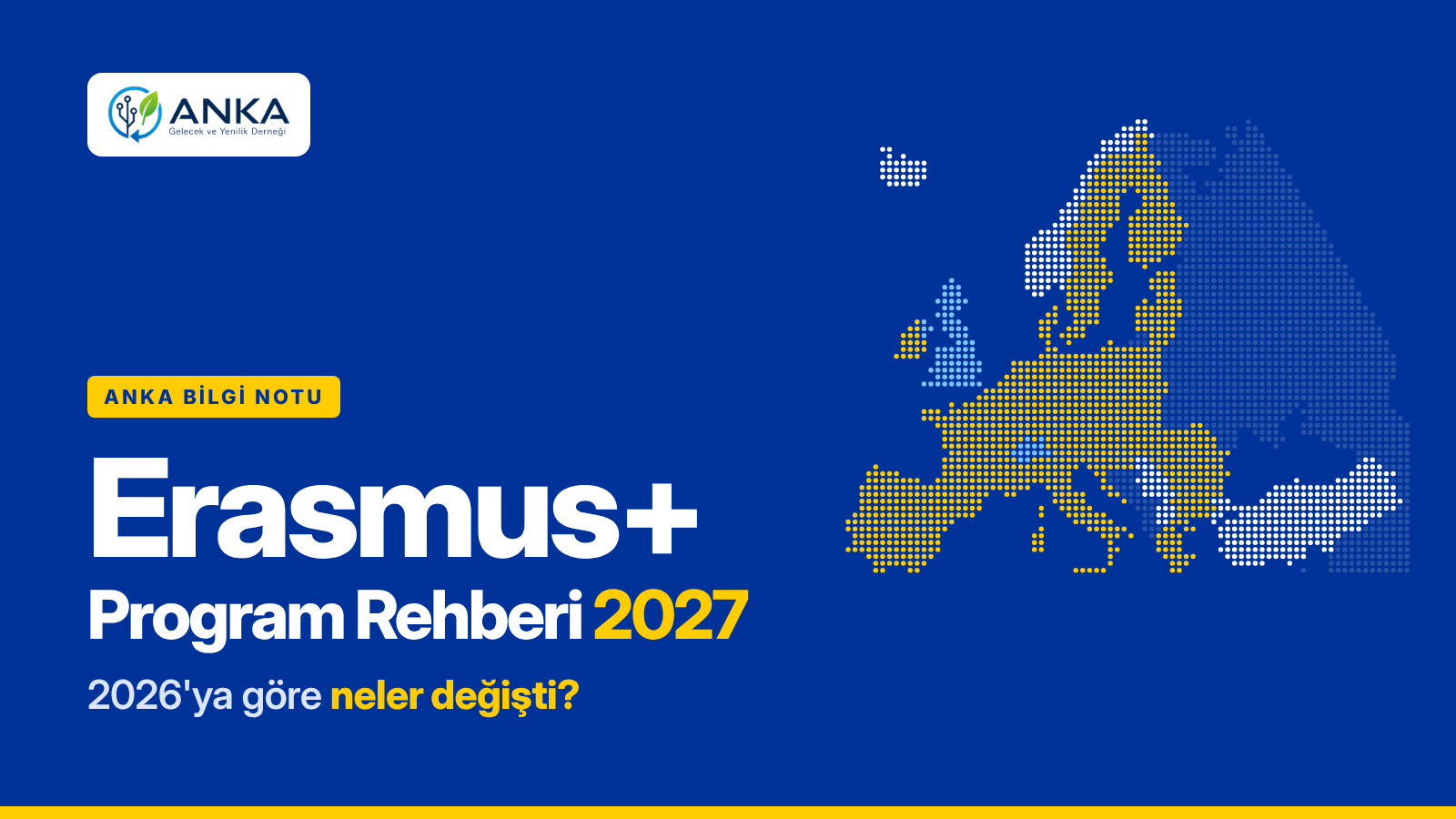
The European Commission published the Erasmus+ Programme Guide 2027 alongside the 2027 call for proposals on 18 November 2026. The final guide of the 2021–2027 programming period introduces changes to accreditation, assessment thresholds for partnership projects, mobility conditions and application deadlines. At ANKA Future and Innovation Association, we have brought together the differences between the 2026 and 2027 guides in a 15-page briefing.
The 2027 call has a total budget of approximately €5.36 billion. The programme’s core structure and many grant amounts remain in place, while priorities relating to basic skills, teaching, digital technologies and artificial intelligence have been updated. This comparison is based on Version 1, dated 18 November 2026.
Key changes in Erasmus+ 2027
| Area | 2026 | 2027 |
|---|---|---|
| Accreditation in vocational education and training, school education, adult education and youth | Accreditation calls open to new applicants | Reaccreditation for existing holders; deadline: 30 September |
| KA220 minimum relevance score | 13 out of 25 | 18 out of 25; overall threshold remains 70 |
| KA210 minimum relevance score | 15 out of 30 | 21 out of 30; overall threshold remains 60 |
| Short-term mobility project duration | 6–18 months | 6–24 months |
| Scope of short-term projects | Limit of 30 participants per application | Limit removed; National Agencies may set a maximum grant |
| KA210 and KA220 first round | 5 March 2026 | 9 March 2027 |
Erasmus accreditation in 2027: Who can apply?
There is no separate call for first-time accreditation applicants in vocational education and training, school education, adult education or youth. The reaccreditation call is open to existing accreditation holders. The deadline is 30 September 2027 at 12:00 Brussels time.
Assessment will follow a pass/fail approach based on previous report scores, budget utilisation rates where required, and compliance with implementation obligations. The relevant National Agency will announce the exact thresholds and detailed conditions. Successful organisations will have their accreditation extended until 31 December 2034, subject to continued compliance with the call conditions. Accreditation does not automatically entitle an organisation to a grant.
A separate call for new accreditation remains available for higher education mobility consortium coordinators. In vocational education and training, school education and adult education, the route to future accreditation after successfully completing short-term projects depends on conditions to be announced by the National Agency. Youth organisations can consider the relevant mobility calls that do not require accreditation, subject to each call’s own rules.
Higher scoring thresholds for KA210 and KA220
KA220 Cooperation Partnerships require at least 18 out of 25 for relevance. For KA210 Small-scale Partnerships, the minimum is 21 out of 30. The overall minimum scores remain 70 and 60 respectively. Applicants must also meet the minimum scores for the other assessment criteria.
Applications therefore need a clear link between the evidence underpinning the needs analysis, the target group’s needs and the selected programme priority. An application that falls below the relevance threshold cannot be considered for funding, even if its overall score is sufficient. Meeting the thresholds does not guarantee a grant; ranking and the available budget also matter.
Activities must generally take place in the countries of the beneficiary organisations. The guide provides exceptions for duly justified activities at EU institutions and, under KA220, activities to share project results. Applicants’ and partners’ activities and experience in the relevant field are also considered during assessment.
What has changed for short-term mobility projects?
In vocational education and training, school education and adult education, short-term projects can now last 6–24 months, and applications by consortia are possible. The limit of 30 participants per application and the restriction of no more than three grants within five call years have been removed. National Agencies may set a maximum grant amount per project.
Organisational capacity, learning objectives, the feasibility of activities and the relevant call’s limits on the number of applications continue to apply. Applicants should check the sector-specific sections of the official Programme Guide before setting participant numbers and budgets.
Teacher Academies 2.0 and school partnerships
Erasmus+ Teacher Academies 2.0 focuses on the development of early-career teachers and school leaders. The maximum grant is €1.5 million per project, with an application deadline of 23 February 2027.
European Partnerships for School Development must target measurable improvement in at least one of the following areas: literacy, mathematics, science, digital skills or citizenship skills. Applications should explain the baseline, the educational need and how progress will be measured. The deadline is 9 March 2027.
Erasmus+ 2027 application deadlines
The table below covers the calls discussed in this article. All times are Brussels time. Consult the official sources for the full timetable, corrigenda and any additional application rounds.
| Call | Deadline | Time |
|---|---|---|
| European local sport events and large-scale European events | 19 January 2027 | 17:00 |
| Youth mobility and mobility of sport staff, first round | 11 February 2027 | 12:00 |
| Higher education, vocational education and training, school education and adult education mobility, first round | 18 February 2027 | 12:00 |
| Teacher Academies | 23 February 2027 | 17:00 |
| KA210 and KA220 applications to National Agencies | 9 March 2027 | 12:00 |
| European Partnerships for School Development | 9 March 2027 | 12:00 |
| Capacity Building in Vocational Education and Training | 12 May 2027 | 17:00 |
| Alliances for Innovation | 14 September 2027 | 17:00 |
| Reaccreditation | 30 September 2027 | 12:00 |
| Erasmus+ Virtual Exchanges | 12 October 2027 | 17:00 |
The 19 January deadline for sport events does not apply to every sport call. Sport partnerships and mobility of sport staff have separate deadlines. For European NGO partnership applications submitted to EACEA and for sport partnerships, the 9 March deadline is at 17:00.
Artificial intelligence, participating countries and application rules
AI literacy, the use of digital technologies in education and citizenship skills have a more explicit place in the 2027 priorities. Switzerland and the United Kingdom are listed among the countries associated with the programme. Organisations must consider participation alongside the conditions of the relevant association agreements and the eligibility rules for each action.
Applicants should also check the procedural requirements: written consent to use another organisation’s PIC or OID, health insurance coverage for mobility participants, and the 7,000-character limit for the main text of an appeal following an application.
What should organisations in Türkiye do?
As Türkiye is associated with the programme, organisations may apply as coordinators or full partners where they meet the conditions of the relevant action. Applications for calls managed by National Agencies go to the Turkish National Agency. Centrally managed calls use the relevant European Commission or EACEA application channel.
Accredited organisations should review their implementation and reporting records in preparation for 30 September 2027. KA210 and KA220 applicants should connect their needs analysis to the relevant horizontal or sector-specific priority and explain partners’ responsibilities, experience and measurable results. You can also explore ANKA’s Erasmus+ and youth projects.
Frequently asked questions
When was the Erasmus+ Programme Guide 2027 published?
Version 1 was published on 18 November 2026, together with the 2027 call for proposals.
Can an organisation apply for Erasmus accreditation for the first time in 2027?
The current call in vocational education and training, school education, adult education and youth is for reaccreditation. Higher education mobility consortium coordinators are covered by a separate call. Organisations considering accreditation after short-term projects should follow the National Agency’s conditions.
What scores are required for KA210 and KA220 in 2027?
KA210 requires at least 60 points overall and 21 out of 30 for relevance. KA220 requires at least 70 points overall and 18 out of 25 for relevance. The minimum scores for the other assessment criteria must also be met.
Are the deadlines given in Türkiye time?
No. All times in this article are Brussels time. Check the time difference on the application date and allow enough time to submit the form before the deadline.
Download the ANKA briefing
ANKA Briefing: Erasmus+ Programme Guide 2027 (PDF, 15 pages, in English)
Our 15-page briefing includes comparison tables, the 2027 application calendar, budget charts and a pre-submission checklist. The downloadable document is available in English.
This article and the briefing are provided for information. Before applying, consult the latest official Programme Guide, any corrigenda and announcements from the relevant National Agency. Organisations applying in Türkiye should follow the Turkish National Agency’s announcements.
Sources
European Commission, Erasmus+ Programme Guide 2027 (Version 1, 18 November 2026); Programme Guide 2026 (Version 1, 12 November 2025); 2027 Call for Proposals EAC/A11/2026; 2027 Annual Work Programme, C(2026) 7171. Supplementary comparison source: BRAVO and Brain Tank, comparison note dated 18 November 2026.